How Predictive Maintenance Analytics Stops Equipment Failure: Real Industry Results

Organizations lose $100,000 to $300,000 or more for each hour of downtime. Predictive maintenance analytics helps businesses dodge these massive losses by spotting equipment problems before they surface. The results have been impressive as companies of all sizes use this proactive approach to cut down unexpected breakdowns and make their assets last longer.
The benefits of maintenance analytics go well beyond preventing failures. Deloitte’s research shows some impressive numbers: downtime drops by 35–45%, unexpected breakdowns fall by 70–75%, and maintenance costs decrease by 25–30%. Companies that employ AI-based predictive maintenance can boost their equipment uptime by up to 20%.
Ground examples paint a clear picture of these benefits. PETRONAS has saved $33 million since starting their predictive maintenance program. Duke Energy managed to save over $34 million from a single early-catch event. These aren’t just lucky breaks, they show what happens when companies change from reactive to predictive maintenance strategies.
This piece will show you how predictive maintenance analytics works, get into the machine learning models that power these systems, and break down the data analytics pipeline behind it all. You’ll learn about both the technology basics and ground applications to help you set up predictive maintenance in your operations.
How Predictive Maintenance Analytics Works in Practice
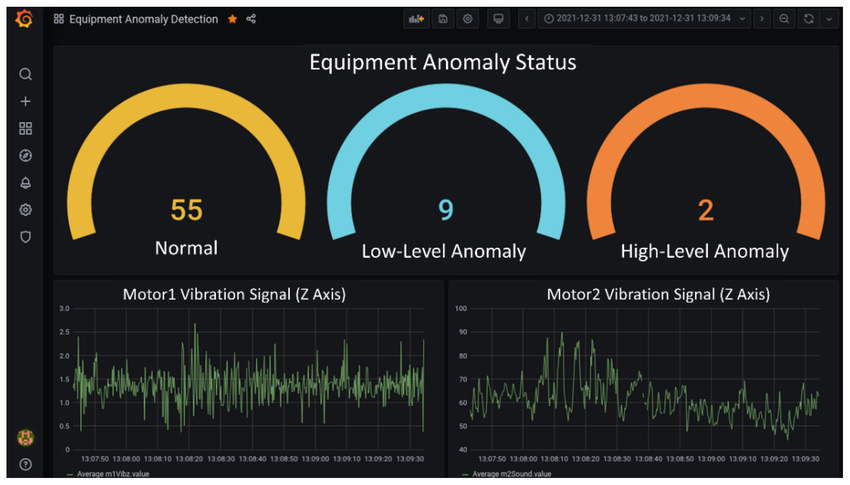
Image Source: ResearchGate
Predictive maintenance analytics works on three main components: sensor data acquisition, immediate monitoring systems, and predictive algorithms. These elements work together to create a continuous feedback loop that turns raw equipment data into applicable information.
Sensor Data Collection: Vibration, Temperature, Pressure
Sensors that collect vital equipment health metrics form the base of predictive maintenance. Vibration analysis is valuable for rotating machinery. Sensors can detect unusual movements that show bearing wear, misalignment, or other mechanical issues. These sensors need a frequency response of 40-50 times the shaft RPM to spot bearing problems effectively.
Temperature monitoring is another vital data source that identifies thermal anomalies. These anomalies might point to electrical faults or mechanical friction. Temperature sensors can detect when equipment heats up after long operation in manufacturing environments. This provides early warning signs of potential failure.
Pressure sensors round out the essential monitoring tools by measuring pressure within machinery systems. These tools are valuable in hydraulic systems and can detect subtle changes before component failures occur.
Industrial condition monitoring applications need sensors that provide:
- Wide frequency response to capture various failure modes
- High measurement resolution and dynamic range
- Long-term stability with minimal drift
- Appropriate operating temperature range (-40°C to +125°C)
Real-Time Monitoring with IoT and Edge Devices
IoT devices and edge computing systems turn collected data into useful insights. Edge devices process data locally before transmission, which enables immediate analysis at the source. This local processing helps time-sensitive applications like predictive maintenance.
Azure IoT Edge platform shows how these systems work by providing immediate information about deployed modules. It reports device status to centralized monitoring services. These platforms organize data into distinct metric groups that track targeted devices, applied deployments, success reporting, and failure reporting.
Edge computing brings clear benefits to maintenance operations. It can monitor equipment conditions and analyze data like temperature, vibration, and energy consumption right at the source. Companies can detect early signs of equipment failure without waiting to send all data to central repositories first.
Failure Prediction Using Time-Series Models
Time series-based methods have improved by a lot through addressing both univariate and multivariate problems. These approaches predict future equipment conditions through prognostic tasks like Remaining Useful Life (RUL) estimation and anomaly detection.
Time series algorithms look for patterns in sensor data to identify potential failures early. Modern predictive models use various machine learning techniques:
- Supervised learning models for failure classification
- Unsupervised learning for anomaly detection
- Reinforcement learning for maintenance scheduling
Recent studies have compared multiple approaches, including logistic regression, random forest, Support Vector Machines, and deep learning methods like LSTM and Transformers. Deep learning approaches work better than traditional machine learning methods only with complex datasets that have various failure patterns.
The prediction window affects how well these predictive models work. All methods become less accurate as the horizon grows because the temporal correlation between input data and predicted events gets weaker. Teams must carefully select appropriate time windows for both reading historical data and making forward predictions.
This three-stage process helps maintenance teams move from reactive maintenance to proactive strategies that prevent equipment downtime from getting pricey.
Machine Learning Models for Predictive Maintenance
Machine learning algorithms are the foundations of predictive maintenance systems. They turn raw sensor data into useful insights. We can split these models into three categories that serve different purposes in maintenance operations.
Supervised Learning for Failure Classification
We trained supervised learning models on labeled datasets that contain known failure patterns. These models connect specific sensor readings to particular outcomes and predict failures. The models’ success depends on good quality training data in sufficient quantities.
Several algorithms work well for predictive maintenance:
- Support Vector Machines (SVM) create optimal hyperplanes that separate data points of different classes in feature space
- K-Nearest Neighbors (KNN) classifies based on the majority class of closest data points
- Random Forest combines multiple decision trees to improve stability and accuracy
- Decision Trees with boosting variants like XGBoost, Gradient Boosting, and CatBoost
Studies show XGBoost consistently shows superior accuracy for failure classification tasks. But Long Short-Term Memory (LSTM) networks work better than traditional machine learning when dealing with complex equipment degradation patterns.
Unsupervised Learning for Anomaly Detection
Unsupervised learning is a great way to get insights especially when you have no labeled failure data – a common situation in new predictive maintenance projects. These algorithms learn normal operation patterns and flag any unusual behavior as potential issues.
Key unsupervised techniques include:
K-means clustering groups similar operating conditions to spot outliers easily. Isolation Forests find anomalies first instead of defining normal behavior. They give anomaly scores between 0 and 1 to data points. Gaussian Mixture Models (GMM) learn equipment’s normal condition and calculate likelihood scores to detect changes.
Unsupervised methods excel at finding unknown failure modes. They often give early warnings before conventional monitoring systems. This makes them valuable for critical infrastructure where failures have serious risks.
Reinforcement Learning for Maintenance Scheduling
Reinforcement learning brings a fresh approach to predictive maintenance. We used it to optimize maintenance timing and resource allocation. Unlike other methods, these algorithms learn through environment interaction and make decisions that maximize long-term rewards.
These algorithms improve maintenance planning by:
- Creating effective maintenance policies for complex, multi-unit systems
- Updating schedules as new information arrives
- Finding the right balance between time slack reduction and equipment ground time
A study of aircraft maintenance showed how reinforcement learning improved fleet availability. It reduced unnecessary maintenance while making task scheduling better. Another study with fuel cell systems proved that reinforcement learning could set preventive control limits and inspection intervals to minimize maintenance costs.
Reinforcement learning might be new, but it offers a strong framework that connects condition-based maintenance models with optimization techniques.
Data Analytics Pipeline for Predictive Maintenance
Data analytics pipelines power predictive maintenance systems. They connect raw equipment data through multiple processing stages and lead to applicable maintenance decisions.
Data Preprocessing and Feature Engineering
Raw sensor data needs thorough preprocessing to produce meaningful results. The original cleaning and preparation phase makes up about 70% of most data science projects. Several vital steps make preprocessing work:
- Data cleaning – This removes outliers, fills missing values, and eliminates noise through filtering or smoothing
- Transformations – The process converts between time and frequency domains for vibration analysis
- Detrending – The system removes systematic effects to focus on meaningful fluctuations
- Feature extraction – The process derives condition indicators that change predictably as system performance degrades
Signal processing techniques designed for mechanical systems help characterize vibrations in the time domain. Frequency-domain analysis detects changes in resonant frequencies or new vibrational components that might show developing faults.
Predictive Maintenance Data Integration from CMMS
Computerized Maintenance Management Systems (CMMS) provide vital data. These systems combine with sensor data to create a complete view of asset health. The integration follows a specific taxonomy that matches the CMMS structure, it starts with factories, sections, subsections, and individual assets.
Each asset has defined critical attributes: asset type, criticality level, applicable predictive techniques, and detectable failures. This integrated approach ensures maintenance records, equipment specifications, and up-to-the-minute condition data combine smoothly into a unified analysis platform.
Maintenance teams can trace each predictive diagnosis to its repair work order. Organizations learn about relationships between diagnoses from different technologies and track maintenance effectiveness over time.
Visualization and Alerting with BI Dashboards
Business Intelligence (BI) dashboards reshape complex predictive analytics into visual displays. Maintenance teams interpret these displays with ease. Power BI, to name just one example, combines data from sensors and maintenance records to create complete visualizations.
These dashboards enable condition monitoring by processing sensor data and updating visualizations right away. Automated alerts trigger when equipment readings exceed predefined thresholds. Maintenance personnel receive immediate notifications about potential issues.
BI tools unite metrics like temperature, vibration, and wear patterns into visual displays. These displays identify unusual equipment behavior before failures occur. Maintenance managers can monitor equipment health in multiple locations. They detect degradation patterns and receive early warnings about abnormal conditions.
Real Industry Results from Predictive Maintenance AI
Predictive maintenance AI delivers measurable financial returns by preventing equipment failures across industries. Companies that use predictive analytics have transformed their maintenance operations from reactive responses to proactive strategies.
Case Study: $33M Savings at PETRONAS
PETRONAS, a major energy company, saved $33 million by using AI-powered analytics to optimize their asset reliability. The company’s predictive maintenance program boosted asset utilization by 0.1% per plant. Early detection systems caught 51 warnings, including 12 high-risk alerts. The program proved its worth with an impressive 20x return on investment. These results show that predictive maintenance analytics makes solid financial sense.
Case Study: Duke Energy’s $34M Early Catch
Duke Energy built a central monitoring and diagnostics center that uses AI-powered predictive analytics. The utility company avoided a single equipment failure that would have cost them $34 million. Ontario Power, which produces clean energy in Canada, had similar success. They saved $400,000 through nuclear predictive analytics and another $200,000 with hydroelectric early detection. A single prevented equipment failure can pay for the entire predictive maintenance system.
FleetDynamics: Brake System Optimization with Digital Twins
GlobalFleet Logistics used digital twin technology to monitor brake systems on their 1,200 commercial vehicles. This switch from reactive to predictive maintenance cut brake-related incidents by 67% and slashed maintenance costs in half. The company saved $6.5 million yearly and recovered their investment in just 4.8 months. Their success shows how predictive maintenance analytics can boost both safety and efficiency.
Wind Turbine Gearbox Monitoring: 20% Downtime Reduction
Wind farm operators spend up to 30% of total costs on operation and maintenance. Advanced gearbox monitoring systems help wind turbines produce 10% more energy. Data fusion algorithms can spot planetary stage gearbox problems weeks before standard diagnostic tools. Modern gearbox monitoring systems handle the complex nature of wind turbine operations and interpret data during changing speeds and loads automatically.
Challenges and Best Practices in Implementation
Predictive maintenance analytics offers proven benefits, but its implementation presents major challenges. Success depends on several key factors that need careful attention.
Data Quality and Labeling for Model Accuracy
The foundation of reliable predictive models starts with data quality. Poor-quality data can create inaccurate predictions or misleading models. In fact, teams spend up to 80% of project time on data preparation. Maintenance teams must clean out noise, duplicates, and missing values that can harm predictive models. Accurate data labeling needs deep knowledge of equipment failure modes from domain experts. Companies should set up validation checks and anomaly detection right at the data ingestion stage.
Integration with Existing Maintenance Workflows
Teams should treat predictive maintenance as a way to build organizational capabilities rather than just another technology project. The biggest problem lies in bridging the cultural gap between maintenance teams and AI experts. The program will work better with clear maintenance protocols, response procedures for different alert levels, and specific tools for each alert type. Cross-functional collaboration between maintenance, operations, and IT teams will give a lasting program operation.
Continuous Model Retraining and Feedback Loops
Model accuracy gets worse over time due to model drift and concept drift. Setting up feedback systems to share successful tests and analyze failures helps with continuous improvement. Teams can configure monitoring systems like Amazon CloudWatch to get alerts when model quality drops. They can then create event rules to spot anomalies and start retraining pipelines. Regular model retraining every 3-6 months improves prediction accuracy by 15-25% within the first year.
Conclusion
Predictive maintenance analytics reshapes how organizations handle equipment reliability and operational efficiency. This piece explores a technology that spots potential failures before they happen. Companies save millions in downtime costs and their assets last longer. A powerful system emerges from a three-stage process: sensors collect data, IoT devices monitor it immediately, and time-series models predict failures.
Machine learning powers these systems at their core. Supervised learning classifies failures while unsupervised learning spots anomalies. Maintenance scheduling improves through reinforcement learning. The technology processes data through a complete pipeline. It cleans raw sensor inputs and extracts meaningful features. The system integrates with existing maintenance tools and shows practical insights through accessible dashboards.
Ground results tell a compelling story. PETRONAS saved $33 million with a 20x return on investment. Duke Energy stopped a single failure that would have cost $34 million. FleetDynamics saw brake-related incidents drop by 67% and maintenance costs fall by half. These examples show why predictive maintenance marks a fundamental change from reactive repairs to strategic asset management.
Organizations must prepare to tackle challenges in data quality, workflow integration, and model maintenance when implementing these systems. Success relies on cooperative teamwork, domain expertise to label data accurately, and steady model retraining.
Evidence shows that predictive maintenance analytics brings substantial value to any industry. Companies that adopt this approach gain an edge through less downtime, longer equipment life, and budget-friendly solutions. Without doubt, predictive maintenance will become vital to future-focused industrial operations as technology advances.
Key Takeaways
Predictive maintenance analytics transforms reactive maintenance into proactive strategies, delivering substantial cost savings and operational improvements across industries.
• Massive cost savings proven: Companies like PETRONAS saved $33M with 20x ROI, while Duke Energy prevented a single $34M failure through early detection.
• Three-stage system drives success: Sensor data collection, real-time IoT monitoring, and ML-powered failure prediction create comprehensive equipment health insights.
• Machine learning enables precise predictions: Supervised learning classifies failures, unsupervised learning detects anomalies, and reinforcement learning optimizes maintenance scheduling.
• Data quality determines model accuracy: 70-80% of project time involves data preprocessing, requiring domain expertise for proper labeling and continuous model retraining.
• Integration challenges require cross-functional collaboration: Success depends on bridging cultural gaps between maintenance teams and AI experts while establishing clear response protocols.
The evidence is clear: organizations implementing predictive maintenance analytics achieve 35-45% downtime reduction, 70-75% elimination of unexpected breakdowns, and 25-30% maintenance cost reduction. This technology represents a fundamental shift toward strategic asset management that delivers competitive advantages through extended equipment life and significant operational improvements.
FAQs
Q1. How does predictive maintenance analytics help prevent equipment failures? Predictive maintenance analytics uses sensor data, real-time monitoring, and machine learning algorithms to identify potential equipment failures before they occur. This approach allows businesses to schedule maintenance precisely when needed, reducing unexpected breakdowns and extending asset lifespan.
Q2. What are the key components of a predictive maintenance system? A predictive maintenance system typically consists of three main components: sensor data collection (e.g., vibration, temperature, pressure), real-time monitoring using IoT and edge devices, and failure prediction using time-series models and machine learning algorithms.
Q3. What types of machine learning models are used in predictive maintenance? Predictive maintenance employs various machine learning models, including supervised learning for failure classification, unsupervised learning for anomaly detection, and reinforcement learning for maintenance scheduling optimization. These models analyze patterns in sensor data to predict potential equipment issues.
Q4. What are some real-world examples of predictive maintenance success? Several companies have achieved significant results with predictive maintenance. For instance, PETRONAS saved $33 million with a 20x return on investment, while Duke Energy prevented a single failure that would have cost $34 million. FleetDynamics reduced brake-related incidents by 67% and cut maintenance costs in half.
Q5. What challenges should companies consider when implementing predictive maintenance? Key challenges in implementing predictive maintenance include ensuring data quality and proper labeling for model accuracy, integrating the system with existing maintenance workflows, and establishing continuous model retraining and feedback loops. Successful implementation requires cross-functional collaboration and a commitment to ongoing improvement.