Voice of Customer Analytics: Hidden Patterns Your Business Is Missing

Here’s a surprising fact only 1 in 26 unhappy customers actually complain. The rest just walk away. Customer feedback analytics shows patterns that businesses miss every day.
Companies that use customer feedback analytics see their revenue grow 10x faster than competitors. But many businesses find this challenging because customer feedback programs need two key things: quality data and proper analysis methods. Your business needs more than just basic customer understanding to succeed. That’s why we’ve created this detailed guide to help you spot patterns that show how customers make decisions and behave.
This piece shows you the quickest way to gather practical customer feedback from different channels. You’ll learn to analyze customer feedback data and spot hidden signals that affect your profits. We’ll also look at the best customer feedback tools that can change how you understand and act on customer insights.
Understanding Voice of Customer Analytics in 2024
Voice of Customer Analytics provides in-depth insights into customers feedback to understand their needs, wants and expectations.
SentiSum Editorial Team, Industry-leading VoC analytics provider
Voice of Customer (VoC) analytics has changed by a lot over the last several years. It has become a vital component for businesses that want to understand their customers’ needs and expectations better. Customer feedback helps companies make strategic decisions that affect satisfaction and loyalty directly.
What is Voice of Customer Analytics?
Companies use Voice of Customer analytics as a strategic framework to capture, analyze, and act on customer feedback at every touchpoint of the customer experience. VoC analytics does more than just collect feedback – it creates a complete intelligence system that turns raw feedback into practical insights.
At its core, VoC involves:
- Complete feedback capture from platforms of all types from traditional surveys to digital channels like social media and mobile apps
- Analysis of feedback to find patterns, priorities, and pain points using techniques such as sentiment analysis and text analytics
- Integration of insights into business operations to improve product design, marketing strategies, and customer service
VoC analytics does more than gather opinions. It processes customer sentiments methodically to find what they really think, need, and expect from your business. Research shows 85% of respondents have experienced firsthand the disruptive effects in their daily lives. This makes it vital for businesses to understand these changes through proper analytics.
How VoC Is Different from Traditional Feedback
Today’s VoC analytics shows a fundamental change from old feedback methods. Modern VoC programs offer several unique advantages over traditional approaches:
Traditional feedback relies heavily on periodic surveys that create easy-to-measure metrics like NPS, CES, or CSAT. These metrics capture just a moment in time and lack context. Modern VoC analytics combines feedback from multiple channels to create an ongoing, all-encompassing view of customer sentiments.
Modern VoC solutions now include:
- AI-powered analytics that process huge amounts of unstructured data quickly
- Natural language processing that detects sentiment, sarcasm, and dialect variations
- Predictive capabilities that forecast customer behaviors and priorities before problems arise
Companies that use complete VoC analytics programs see 3-5x higher retention rates. They also report better customer lifetime value through systematic feedback analysis.
Why Businesses Miss Hidden Patterns
Businesses have more data than ever before. Yet many organizations can’t extract meaningful insights from their VoC initiatives. Research shows only about half of all businesses (51%) successfully put customer feedback to use. This leaves valuable patterns undiscovered.
Several reasons explain this intelligence gap:
- Data Silos: Customer feedback stays trapped inside disconnected systems. This prevents a unified view of the customer experience.
- Overreliance on Traditional Methods: Many businesses focus too much on surveys alone. They miss the rich context available through other channels.
- Limited Analytical Capabilities: Companies without AI and machine learning tools can’t process the volume and variety of feedback effectively.
- Lack of Integration: Companies fail to combine VoC insights with financial and operational data. This limits customer feedback’s business effect.
Social media posts might reveal different patterns than survey responses or contact center interactions. Without combining these diverse sources, businesses miss the complete picture. They especially miss the emotional undertones and context that drive customer decisions.
The most valuable patterns exist where different data sources intersect. Companies need sophisticated analytical approaches to find and interpret them properly.
Collecting Actionable VoC Data Across Channels
Great voice of customer programs don’t rely on just one feedback channel. They create systems that get insights from multiple angles and balance structured and unstructured data. Your business needs a strategy to collect and analyze customer feedback through several channels. Customers will talk about your brand whether you’re listening or not.
In-App Surveys vs. Email Surveys
In-app and email surveys are two different ways to gather customer feedback. Each brings its own benefits to the table.
In-app surveys get immediate, rich feedback while users guide themselves through your website or mobile app. These surveys work well because people respond right away and share specific details about their experience. To name just one example, when a visitor spends time on a product page, a quick survey can capture their thoughts at that exact moment. This reveals significant information about their experience.
Email surveys let you reach customers even when they’re not using your product. People tend to give more thoughtful, complete responses since they have time to think over their overall experience. Notwithstanding that, email surveys struggle with lower response rates, averaging just 10-15% based on research.
Your specific goals determine which method works best:
- In-app surveys work for: quick feedback, high response rates, specific feature feedback
- Email surveys work for: complete feedback, reaching occasional users, detailed quality insights
In-app messaging paired with usage analytics helps you target specific audiences with relevant questions. This precise targeting lets you collect feedback from real customers while they use the process you want to learn about.
Social Listening and Review Monitoring
Social listening tracks social media platforms, websites, forums, and even podcasts. This gives you direct access to real, relevant conversations about your brand. You can monitor both direct mentions and indirect references to your products or industry.
Businesses can use social listening to:
- Keep up with trends by finding emerging topics
- Make customer experience better by fixing pain points early
- Shape product development with real feedback
- Guard brand reputation by catching negative feedback quickly
Online reviews offer valuable VoC data without asking customers directly. Google Reviews, Yelp, Trustpilot, and industry-specific platforms show unfiltered customer opinions. Research shows 93% of customers read online reviews before buying, which makes monitoring these platforms vital.
Customer Support Interactions as Data Sources
Support teams talk to customers every day about problems, questions, and frustrations. These conversations hold precious voice of customer data when properly captured and analyzed.
Sales teams and customer service staff interact with buyers regularly and provide direct feedback sources. Regular interviews with these employees help you find out customer’s thoughts and views about your brand. On top of that, you can listen to recorded calls and extract passive feedback through comments, tone, or behavior.
Customer support interactions offer several benefits as VoC data sources:
- They show unfiltered customer concerns
- They capture emotional context that surveys often miss
- They highlight common issues that other feedback channels might miss
- They show how well your team fixes problems
Behavioral Tracking Across the Customer Journey
Voice of customer doesn’t always need questions actions often tell more than words. Looking at login frequency, feature adoption, and workflow completion rates gives powerful insight into customer’s value experience and struggle points.
Behavioral analytics data shows you what customers who don’t give feedback think (the vast majority), and helps explain the feedback you receive. You can use heatmaps to see website drop-off points, letting your team break down specific issues.
Customer journey analytics looks at data like customer insights, online and offline attribution, and direct customer feedback from various sources. Analysis of the entire customer journey helps identify potential bottlenecks and boost retention while driving better business results.
The best VoC data collection needs a balanced approach across multiple channels. Effective programs combine feedback from various sources to paint a complete picture of customer experiences, feelings, and behaviors.
How to Analyze Voice of Customer Data Effectively
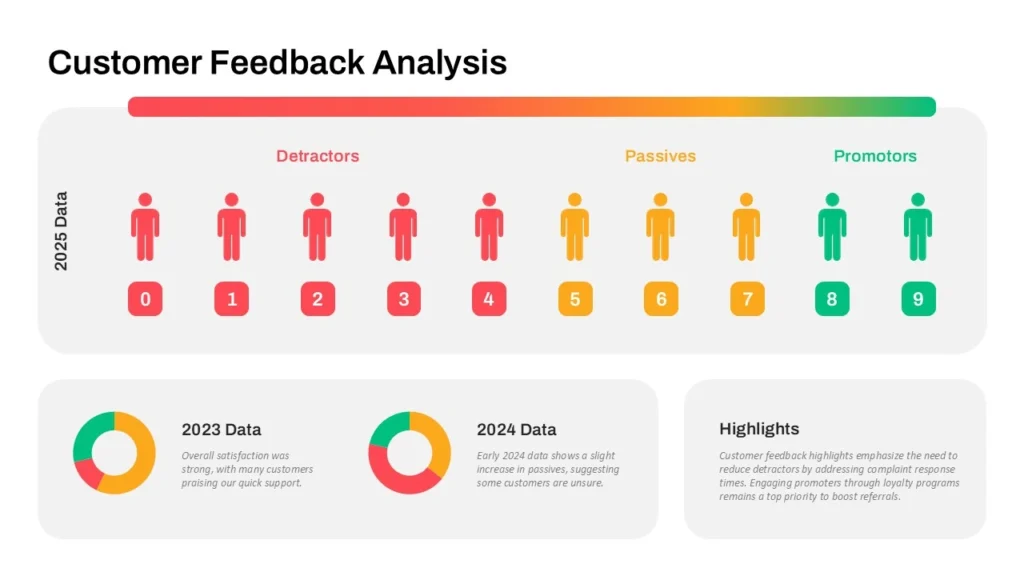
Image Source: SlideKit
Voice of customer analytics (VOC) turns raw feedback reviews, support chats, social rants into your product roadmap.
42Signals Editorial Team, Consumer behavior analytics provider
Raw customer feedback transforms into practical insights through structured analysis. After collecting data from multiple channels, companies face the challenge of interpreting it through effective voice of customer analytics.
Categorizing Feedback for Pattern Recognition
A solid categorization system forms the basis of meaningful customer feedback analysis. This system helps spot patterns, set priorities, and monitor trends over time. Your organization should create a consistent tagging system with:
- Clear hierarchical categories that match key business areas
- Sub-categories for more specific classification
- Multiple tags when feedback covers different areas
- AI-powered tagging that ensures speed and consistency
Text analysis algorithms can process huge amounts of feedback quickly, while human review adds nuanced understanding. The best approach combines both – AI handles the first round of sorting, then analysts review everything to ensure context and accuracy.
Combining Survey and Behavioral Data
Survey responses paired with behavioral data create deeper, more practical insights. Research shows that “While behavioral analytics helps you understand VoC feedback, VoC feedback also helps uncover the causes behind confusing behavioral trends revealed through analytics. It’s a two-way street”.
A company might spot low satisfaction scores in onboarding surveys and run funnel analysis to find exact drop-off points. This method shows both customer opinions and actions – solving a common challenge where behavioral data reveals what happens while VoC analysis explains why.
Using Sentiment Analysis for Emotional Insights
Natural language processing powers sentiment analysis to decode emotional messages behind words. Modern sentiment analysis goes beyond basic positive/negative sorting and:
- Gives numerical scores to feedback (typically from -1 to +1)
- Groups responses by emotional states (anger, joy, fear, etc.)
- Spots key phrases that trigger emotional responses
One business used sentiment analysis in their feedback program and caught hidden frustrations early. They ended up cutting churn by over 15% within three months. On top of that, it breaks customer feedback into specific parts to show what customers love and what needs work.
Applying Journey Mapping to Identify Drop-Off Points
Journey mapping shows the complete customer experience and reveals issues at each step. This method requires:
Creating a detailed map of each customer interaction step with related emotions and pain points. A sentiment line below the journey map reveals how emotional experiences shift throughout.
Journey mapping tools gather step-by-step information and present it clearly, showing how customers move across digital channels. This helps businesses spot trouble areas, reimagine their service, and boost overall customer satisfaction.
Hidden Patterns That Predict Purchase Decisions
Customer data contains hidden patterns that reveal more about purchase intent than direct customer feedback. Let’s get into four analytical approaches that help predict buying decisions.
NPS Scores and Their Association with Retention Rates
Most companies find that Net Promoter Score (NPS) doesn’t strongly associate with customer retention. Research shows that businesses in their industry’s top 25% NPS bracket see only a modest 5-10% increase in renewals. The remaining 75% of companies can’t reliably predict churn using NPS. The real value of NPS shows up in expansion revenue. Companies in the bottom NPS quartile generate 15% less monthly expansion revenue than top performers.
Finding Friction Points in Onboarding
Onboarding friction appears in three layers: functional, social, and emotional. Many businesses focus only on functional friction like technical barriers. The biggest adoption hurdles come from social friction such as IT approval processes and emotional friction from resistance to change. A systematic map of these friction points throughout your customer’s experience helps eliminate adoption barriers.
Feature Adoption Gaps and Their Impact
Feature adoption data predicts retention effectively. Studies reveal that 40% of churned customers never used key features fully. Companies with better feature engagement show lower churn rates and better NPS scores. Activation rate tracking helps spot where users face adoption challenges.
Pain Points Specific to Demographics
Customer segments face unique challenges throughout their experience. Voice of customer analytics spots these segment-specific issues through association analysis between demographic variables and satisfaction scores. These pain points fall into three groups: financial constraints, inefficient processes, and missing features. Companies create more effective messaging that boosts engagement by segmenting audiences based on these specific challenges.
Top Voice of Customer Analytics Tools to Consider
The right tools are the foundations of a successful voice of customer analytics strategy. Here are four powerful tools you should think about for your VoC approach.
Userpilot: In-App Surveys and Behavioral Tracking
Userpilot stands out by collecting user feedback inside your application while it tracks behavior. The platform goes beyond basic surveys with advanced user segmentation, inactivity skipping, and activity log panels that give you a detailed record of user actions. It blends feedback collection with analytics features and lets you build targeted in-app surveys that get high response rates to meet your goals.
Hotjar: Session Recording and Heatmaps
Hotjar gives you a unique way to see user experience through detailed session recordings and heatmaps. The tool tracks over 1.7 billion sessions each year and shows unexpected user behaviors that reveal hidden blockers and confusing flows. Its AI summaries spotlight key moments, and the frustration detection finds errors and performance issues right from session replays.
Brand24: Social Media Sentiment Monitoring
Brand24 keeps an eye on mentions from 25 million online sources immediately and uses AI to tap into conversations on social media, news, blogs, and more. The tool’s advanced sentiment analysis sorts mentions into positive, negative, or neutral categories and works with 108 languages through AI detection.
AI-Powered Tools for Real-Time Feedback Analysis
AI-powered analytics tools handle large amounts of customer feedback quickly and deliver insights through sentiment analysis, natural language processing, and predictive analytics. These tools spot customer concerns faster and help businesses adjust their products based on emerging feedback patterns.
Conclusion
Voice of Customer analytics represents a radical alteration in the way businesses understand their customers. This piece explores how VoC analytics transcends basic feedback collection. It creates a detailed intelligence system that converts raw customer input into strategic business insights. Smart companies that implement these strategies spot hidden patterns their competitors miss completely.
Your business might need to think over its approach to feedback analysis if you struggle with customer retention and growth. Organizations that exploit multi-channel VoC analytics grow revenue 10x faster and experience 3-5x higher retention rates. These remarkable results come from knowing how to capture explicit feedback and implicit behavioral signals throughout the customer’s experience.
Successful VoC programs share key traits – they break down data silos and combine smoothly different feedback sources. They apply sophisticated analytical techniques like sentiment analysis and journey mapping. Purpose-built tools help transform vast amounts of unstructured data into useful insights.
Customer expectations keep changing faster than ever. Modern VoC programs must go beyond traditional surveys. They should encompass social listening, support interaction analysis, and behavioral tracking. Our newsletter keeps you informed about the latest voice of customer analytics trends and tools that help your business spot critical hidden patterns.
Tomorrow’s thriving businesses will be those who listen most effectively today. Voice of customer analytics offers a framework to understand what customers truly mean, not just what they say. It reveals patterns that accelerate growth, loyalty, and green competitive advantage in increasingly crowded markets.
Key Takeaways
Voice of Customer analytics reveals critical business insights that traditional feedback methods miss, helping companies grow 10x faster through strategic customer intelligence.
• Integrate multiple feedback channels: Combine in-app surveys, social listening, support interactions, and behavioral data for complete customer insights beyond traditional surveys alone.
• Focus on hidden patterns over obvious metrics: Correlate NPS with retention rates, identify onboarding friction points, and detect feature adoption gaps that predict purchase decisions.
• Use AI-powered sentiment analysis: Process unstructured feedback at scale to uncover emotional insights and demographic-specific pain points that drive customer behavior.
• Map the complete customer journey: Apply journey mapping to identify drop-off points and combine survey responses with behavioral data for actionable intelligence.
• Deploy specialized VoC analytics tools: Leverage platforms like Userpilot, Hotjar, and Brand24 to capture real-time feedback across 25+ million online sources and transform data into strategic insights.
The most valuable customer insights exist at the intersection of different data sources – only 1 in 26 unhappy customers actually complain, making comprehensive VoC analytics essential for detecting the silent majority’s true sentiments and preventing churn before it happens.
FAQs
Q1. What exactly is Voice of Customer (VoC) analytics? Voice of Customer analytics is a strategic framework that captures, analyzes, and acts upon customer feedback across multiple touchpoints in the customer journey. It goes beyond simple feedback collection to create a comprehensive intelligence system that transforms raw feedback into actionable insights.
Q2. How does VoC analytics differ from traditional feedback methods? Unlike traditional feedback methods that often rely on periodic surveys, VoC analytics integrates feedback from multiple channels to create a continuous, holistic view of customer sentiments. It uses AI-powered analytics to process vast amounts of unstructured data in real-time and incorporates predictive capabilities to forecast customer behaviors.
Q3. What are some effective ways to collect VoC data? Effective VoC data collection involves using multiple channels such as in-app surveys, email surveys, social listening, review monitoring, customer support interactions, and behavioral tracking across the customer journey. Each method offers unique insights and helps create a comprehensive picture of customer experiences and sentiments.
Q4. How can businesses effectively analyze VoC data? Effective VoC data analysis involves categorizing feedback for pattern recognition, combining survey and behavioral data, using sentiment analysis for emotional insights, and applying journey mapping to identify drop-off points. These techniques help transform raw customer feedback into actionable insights that drive business improvements.
Q5. What are some hidden patterns that VoC analytics can reveal about purchase decisions? VoC analytics can uncover hidden patterns such as the correlation between NPS scores and retention rates, friction points in onboarding stages, feature adoption gaps, and demographic-specific pain points. These insights often reveal more about purchase intent than what customers directly communicate, helping businesses predict and influence buying decisions.